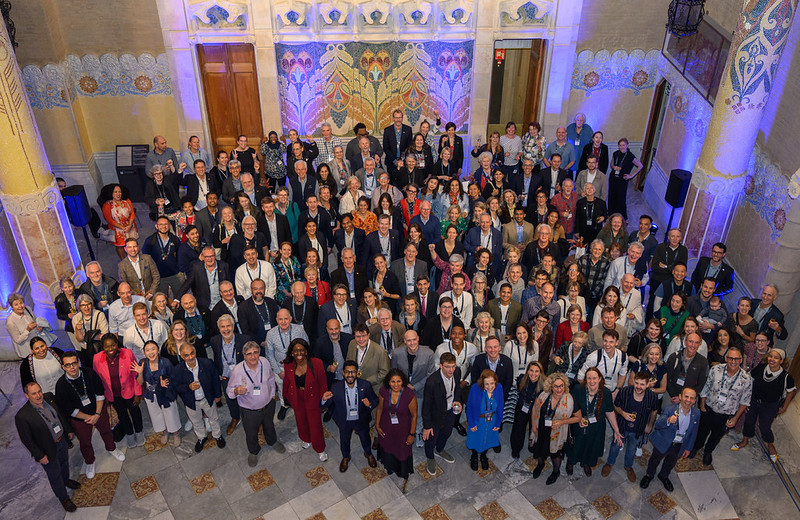
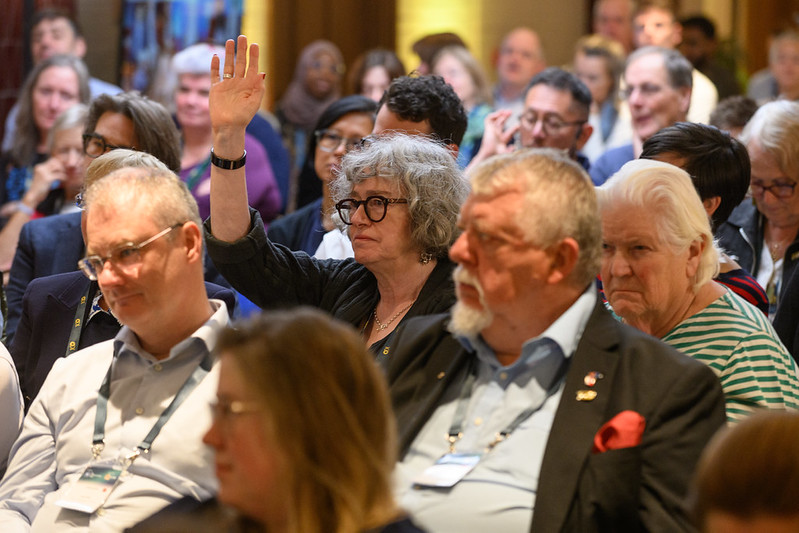
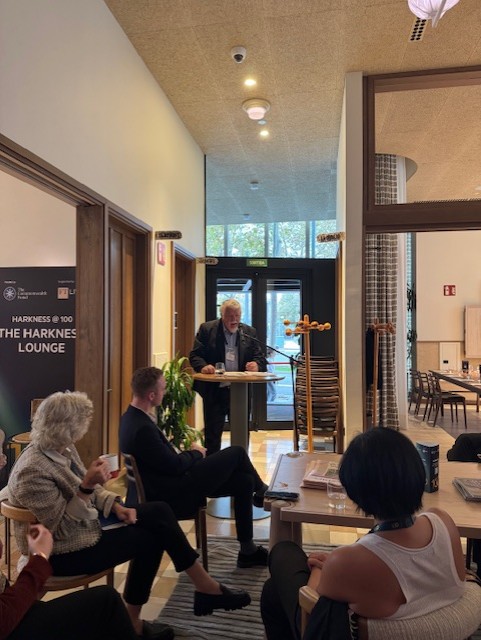
In mid-November 2025, my wife Hanna and I travelled to Barcelona, Spain, to attend celebrations of 100 years of the Harkness Fellowship. I was invited to address the Harkness@100 conference at a session titled “International Relations and Diplomacy: Navigating a Complex World”. My address titled “The Impact of the International Human Rights Law on Domestic Human Rights. The Case of Australia” is attached below.
I was a Harkness Fellow between 1984 and 1986 during Ronald Regan’s presidency. During my time, the Harkness Fellowship program (see: https://harknessfellows.org.uk/history-of-harkness-fellowships) was much broader than it is today, with a focus on Health Care Policy and Practice.
In 1984, fellowships were awarded to four Australians (myself, Christine Nixon, Michael L’Estrange and Glyn Davis) for stays in the United States lasting up to 21 months and including travel across the USA. The Harkness Fellowships were set up in 1925 by Edward Harkness and were envisioned as a “reverse Rhodes Scholarships”. The initial purpose of it was ‘To do something for the welfare of mankind' and to advance international understanding, and in particular to maintain the ‘special relationship’ between the US and the United Kingdom. Now, it provides a unique leadership development experience for mid-career professionals, policymakers and researchers from Australia, Canada, France, Germany, the Netherlands, New Zealand,Norway, Singapore, and the United Kingdom. It is a very exclusive program offering about 40 places. Candidates were expected to demonstrate an excellent academic record as well as leadership potential and exemplary qualities of character, and be under 31 years old.
My wife and I, along with our three children, Adam, Agatha and Alexander, arrived in New York in August 1984 and completed the Harkness Fellowship program in San Francisco in March 1986. I undertook my postgraduate studies at Harvard University, Georgetown University, and the University of California, Berkeley. My research focused on human rights, with a particular emphasis on refugee rights, public administration and maintaining social cohesion in diverse societies.
At Harvard, Professor Nathan Glaser, of the Graduate School of Education, was my research sponsor. I have also attended lectures by Professor Glenn Loury and William Kristol of the J.F. Kennedy School of Government, and worked with Prof. Henry Steiner, Philip Alston, Ewa Eliasz-Brantley, and Novi Pillay at the Harvard Law School, and with many others, focusing mainly on the concepts of equality, racial discrimination, affirmative action and comparable worth. I also held useful meetings with many NGO’s including with Clarence Pendleton, Chair, US Commission of Civil Rights, Alex Rodriques, Chair, Massachusetts Commission Against Discrimination and his senior staff, Jonathan Fine, President, American Committee for Human Rights, Prof. Owen Harries of Heritage Foundation, Prof. Samuel Huntington, William Kristol, Charles Murray, leaders of the National Endowment for Democracy, and many others. I also attended many human rights-focused conferences and visited the Canadian Human Rights Commission and the Commission des droits de la
personne du Québec.
Georgetown University was very different. Rev Thomas Gannon, SJ, Director of the Woodstock Theological Centre, was my sponsor, and I was given an office in the Centre. My research focused on the international human rights system, working with high ranking officials from the Foreign Affairs Committee of the House of Representatives, Department of State (including with Elliot Abrams (who was then Assistant Secretary for Human Rights, US Department of Justice and other Washington bodies, including the US Civil Rights Commission, Heritage Foundation, Centre for Migration Studies, and many others. It was also interesting to meet various scholars of Polish origin, such as Prof. Zbigniew Brzezinski, former National Security Adviser to President Carter; Wladyslaw Sila-Nowicki, a prominent Polish dissident; Jan Nowak-Jezioranski, Radio Free Europe, Tadeusz Wittlin, a writer; Prof.Henry Albinski, Australian Studies Centre, Pennsylvania University; and Jan Karski, a witness of the Holocaust and Czeslaw Milosz, a writer who won Nobel Prize in Literature.
At the University of California, Berkeley, I worked with Professor Frank Newman and many others on the legal status of Latin American asylum seekers and the refugee sanctuary movement. Again, meeting many interesting people, including Prof. Thomas Sowell, of Hoover Institution on War, Revolution and Peace, Stanford University, Paul Hoffman, National Coordinator of US Amnesty International, Peter Schey, Director of LA Center for Immigration Rights and many others.
I also undertook a month-long human rights trip to South America which took me to earthquake-damaged Mexico City, to Peru, dealing with Sandero Luminoso insurgency, to Pinochet’s Chile, where I visited political prisoners in Santiago prison, to Argentina, recovering from martial law, where I spoke to families of the disappeared under the military dictatorship. and to Brazil where I met top human rights lawyers and advocates. On my way back to Australia, I stopped in Geneva to attend the 42nd Session of the UN Commission on Human Rights.
To sum up, the Harkness Fellowship has charged my batteries for many years to come, and my contribution to the well-being of Australian society would not have been possible without it.
My presentation: 2025-11-14 BARCELONA FINAL – HARKNSS@100 PRESENTATION ON HUMAN RIGHTS